
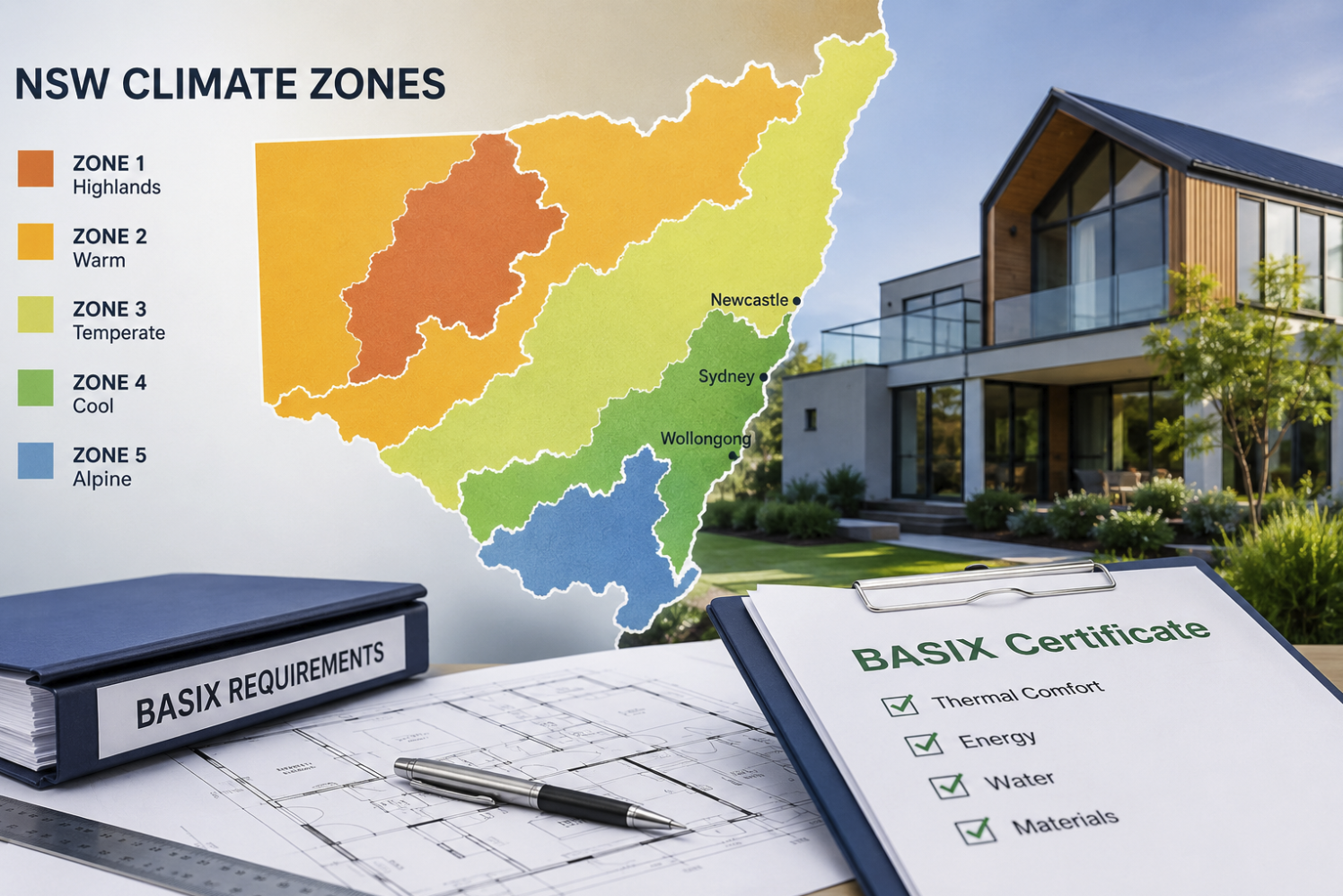
Climate zones play a major role in how BASIX works across New South Wales. While BASIX is often discussed as a single statewide system, the actual requirements are not identical from one location to another. NSW has a wide range of climatic conditions, from warm coastal areas to cooler inland regions and alpine environments. Because of that, the BASIX assessment responds differently depending on where the project is located.
For architects and builders, this is an important part of early design planning. A home that performs well in one part of NSW may need a different approach in another. Orientation, glazing, insulation, shading, ventilation, and heating and cooling strategies can all be affected by climate zone. BASIX uses these differences to set thermal expectations that better reflect local conditions.
This is one reason climate zones are so important in residential design. They influence more than compliance on paper. They shape how a home needs to be designed to achieve comfort, efficiency, and a smoother pathway through approval. Understanding this early can help architects and builders make more informed design decisions and avoid unnecessary redesign later in the process.
Key Takeaways
- BASIX requirements vary across NSW because climate conditions differ from one region to another.
- BASIX assigns thermal performance expectations using NatHERS climate regions based on postcode.
- Climate zones affect design decisions such as glazing, shading, insulation, ventilation, and heating and cooling strategy.
- A design approach that works well in one climate zone may not perform as well in another.
- Architects and builders should consider climate zone early so BASIX and design decisions stay aligned.
- Understanding climate zones helps reduce compliance issues and supports better-performing homes.
Summary Table
| Topic | What It Means |
|---|---|
| Climate zone role | BASIX uses climate information to shape thermal performance expectations for different parts of NSW. |
| How zones are assigned | Climate regions are linked to postcode and assessed through the BASIX and NatHERS framework. |
| Main design impact | Climate zone influences glazing, insulation, shading, orientation, and ventilation choices. |
| Why it matters | Different regions need different design responses to achieve comfort and compliance. |
| Risk of ignoring it | A design that does not respond to climate can create BASIX issues or weaker performance outcomes. |
| Best approach | Check the climate zone early and design with it in mind from the start. |
What BASIX Climate Zones Actually Mean in NSW
BASIX climate zones are part of the way NSW tailors residential sustainability requirements to local conditions. Rather than applying exactly the same thermal expectations to every site, BASIX recognises that homes in different regions experience different patterns of heat, cold, humidity, and seasonal demand. This allows the system to set more suitable expectations for thermal performance.
In practical terms, BASIX assigns maximum heating and cooling loads according to the NatHERS climate region linked to the project postcode. That means the climate conditions associated with the site affect how the thermal side of the BASIX assessment is judged. A dwelling in a cooler inland zone may face different thermal pressures from a dwelling in a warmer coastal zone, even if the building size and layout are similar.
For architects and builders, this means climate zone is not just background data in the software. It directly influences the design response needed to achieve a workable BASIX result. Understanding the climate zone at the beginning of the project makes it easier to develop a design that suits the site, rather than trying to correct performance issues later.
Why the Same House Design Does Not Perform the Same Everywhere
One of the most common design mistakes is assuming that a house design can be repeated across NSW without major changes. In reality, the same home can perform very differently depending on where it is built. A layout that works well in a milder climate may struggle in a hotter or colder zone if the glazing, shading, insulation, and ventilation strategy are left unchanged.
This is exactly why climate zones matter under BASIX. The system is designed to reflect the fact that heat gain, heat loss, and seasonal comfort demands vary by location. A building that is exposed to high summer heat may need stronger shading and careful glazing control, while a building in a cooler area may need a better balance between solar access and heat retention.
For architects and builders, this reinforces the importance of site-responsive design. Repeating standard plans without adjusting them for climate can lead to weaker thermal outcomes and more difficulty achieving compliance. It is usually far more efficient to adapt the design early than to retrofit solutions once the BASIX assessment exposes performance problems.
Which BASIX Design Decisions Are Most Affected by Climate Zone
Climate zone has a strong influence on the design decisions that affect thermal performance most directly. Orientation is one of the clearest examples. In some parts of NSW, winter solar access may be especially valuable, while in others the bigger issue may be limiting overheating during hotter periods. That changes how openings, living spaces, and shading elements should be considered.
Windows and glazing are also heavily affected. The amount of glazing, where it is placed, and how it is shaded can all change the BASIX result depending on the climate zone. Insulation strategy is another major factor, along with ventilation design and the treatment of roofs, walls, and floors. What counts as a practical solution in one region may not be enough in another.
For builders, this has direct consequences on specification and buildability. For architects, it affects concept design from the earliest stage. Climate zone is therefore not just a compliance input. It is a practical design driver that shapes many of the choices that determine whether a home will perform well and pass more smoothly through the BASIX process.
How Climate Zones Influence Thermal Performance and Energy Outcomes
Climate zones affect BASIX most clearly through thermal performance, but the impact does not stop there. When a dwelling is designed appropriately for its climate, it usually performs better overall, which can also support stronger energy outcomes. Better passive design can reduce reliance on mechanical heating and cooling, which is one of the broader goals behind BASIX thermal and energy standards.
This relationship is important because BASIX is not only measuring comfort in isolation. It is also concerned with greenhouse gas reduction and energy efficiency. If a home is poorly matched to its climate zone, it may require more active heating or cooling to remain comfortable. That can make the BASIX pathway more difficult and may also lead to higher running costs for occupants.
For architects and builders, climate-responsive design is therefore both a compliance strategy and a performance strategy. By designing in response to the local climate zone, it becomes easier to support the thermal intent of BASIX while also improving the practical energy performance of the finished home.
Why Early Climate Zone Checks Matter for Architects and Builders
Checking the climate zone early is one of the simplest ways to avoid design inefficiencies later. When the site climate is understood from the beginning, the design team can make better decisions around orientation, glazing, shading, materials, and ventilation before those choices become hard to change. This reduces the chance of having to revise the design once BASIX modelling is underway.
For architects, early climate checks support a more informed concept design process. For builders, they help ensure the planned construction approach is realistic and aligned with the performance expectations for that location. This is especially useful when working across multiple parts of NSW, where assumptions from one region may not transfer well to another.
The practical benefit is not only smoother compliance. It is also better design coordination. When climate zone is considered early, the project is more likely to move through BASIX with fewer surprises and produce a home that feels appropriate to its setting rather than forced into a generic solution.
Final Thoughts
Climate zones are one of the key reasons BASIX is more than a simple one-size-fits-all checklist. They allow the system to respond to the different environmental conditions found across NSW and help shape thermal performance expectations in a way that better suits each site. For architects and builders, this makes climate zone a practical design issue as much as a compliance issue.
The earlier climate zone is considered, the easier it becomes to align design decisions with BASIX requirements. That usually leads to stronger thermal outcomes, fewer compliance headaches, and homes that are more comfortable and efficient in real conditions. For projects across NSW, climate-responsive design is not just best practice. It is a core part of getting BASIX right.
FAQs
1. How do climate zones affect BASIX in NSW?
Climate zones affect the thermal expectations used in BASIX. The system assigns heating and cooling limits according to the NatHERS climate region linked to the project postcode, which means site location directly affects how thermal performance is assessed.
2. Does BASIX use NatHERS climate zones?
Yes. BASIX uses NatHERS climate regions for thermal performance purposes, based on postcode. This is one of the reasons BASIX and NatHERS are often discussed together in NSW residential design.
3. Can the same house design be used in different NSW climate zones?
It can be used as a starting point, but it often needs adjustment. The same design may not perform equally well across different climate zones, which is why glazing, shading, insulation, and ventilation often need to change from one location to another.
4. What design elements are most affected by climate zone?
The main design elements affected by climate zone are orientation, glazing, shading, insulation, ventilation, and broader heating and cooling strategy. These decisions strongly influence thermal performance.
5. Why should architects check climate zone early?
Checking climate zone early helps architects shape a more site-responsive design before key decisions are locked in. It can reduce redesign later and make the BASIX process smoother.
6. Do climate zones affect BASIX energy standards as well as thermal performance?
Yes, climate zones influence more than just thermal comfort. They also affect the broader way BASIX energy performance is considered, particularly where passive design choices influence heating and cooling demand.