
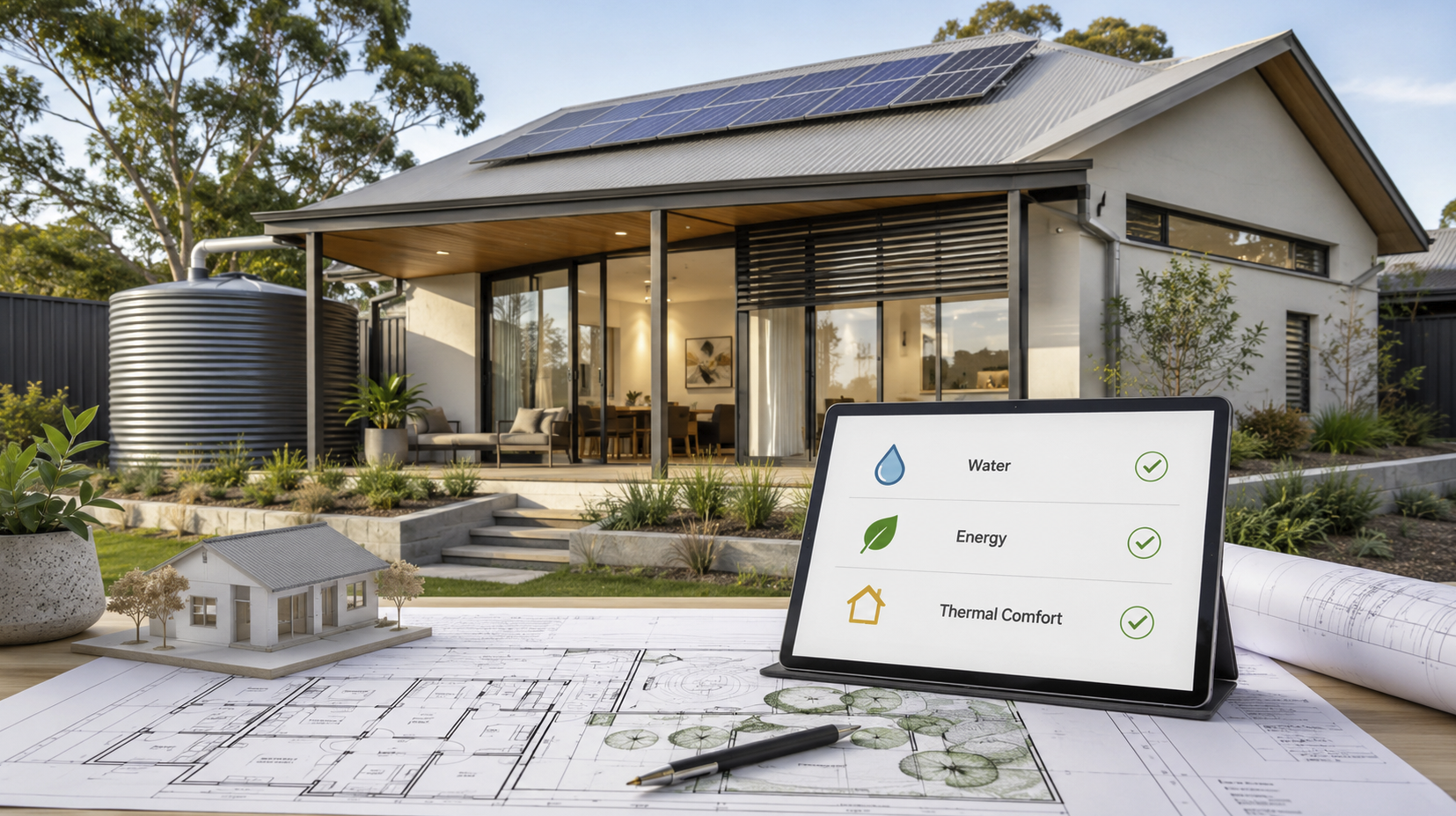
If you are new to BASIX, one of the easiest ways to get lost is in the word “targets”. Homeowners often hear that a project has to meet BASIX targets, but it is not always obvious what those targets actually mean in practical terms. In NSW, BASIX is built around three main performance areas: water, energy, and thermal comfort. Together, these targets help shape how a home is expected to perform before it is approved.
Rather than simply asking whether a home includes certain products or features, BASIX looks at whether the design can achieve required sustainability outcomes. That is why the assessment is based on more than a checklist. It considers things like fixtures, glazing, insulation, heating and cooling loads, and the overall design response to the site and climate.
For homeowners, understanding BASIX targets makes the whole process less intimidating. Once you see how the water, energy, and thermal comfort sections work together, it becomes much easier to understand why certain design choices matter and why BASIX is a core part of the NSW approval pathway.
Key Takeaways
- BASIX is built around three core performance areas: water, energy, and thermal comfort.
- Water targets focus on reducing potable water use in residential development.
- Energy targets focus on reducing greenhouse gas emissions from household energy use.
- Thermal comfort targets focus on how well a home performs in summer and winter without over-relying on mechanical heating and cooling.
- BASIX targets vary by dwelling type and location, rather than applying exactly the same standard to every project.
- The BASIX Certificate records the sustainability commitments that form part of the approved design.
Summary Table
| BASIX Target Area | What It Looks At | Why It Matters |
|---|---|---|
| Water | Potable water use and water-saving measures | Helps reduce household water consumption |
| Energy | Household energy demand and related greenhouse gas emissions | Supports lower emissions and better energy efficiency |
| Thermal Comfort | Heating and cooling loads, passive design, and construction performance | Helps homes stay comfortable with less reliance on mechanical systems |
| Climate influence | Local conditions and postcode-based settings | Makes BASIX more responsive to the location of the project |
| Project outcome | Sustainability commitments listed on the certificate | Ensures approved design measures are carried through |
What BASIX Targets Actually Mean
BASIX targets are the sustainability benchmarks a residential project must meet before a BASIX Certificate can be issued. In simple terms, they are the required performance outcomes for the project across water, energy, and thermal comfort. If the proposed design does not meet those targets, the BASIX assessment will not be able to generate a compliant certificate.
This is important because BASIX is not just asking whether a project includes a rainwater tank, certain windows, or a particular type of insulation. It is looking at the broader result those design choices create. The targets are there to show whether the home is likely to perform in a more sustainable way than older, pre-BASIX housing.
For homeowners, the easiest way to think about BASIX targets is as performance goals rather than simple product rules. Different design combinations may still achieve the required result, which is why the BASIX process often involves balancing multiple factors rather than relying on one single feature.
How the Water Target Works
The water target in BASIX is focused on reducing potable water consumption in residential development. In practical terms, this means the assessment looks at how the proposed home is expected to reduce reliance on mains drinking water compared with older benchmark housing. The water section may be influenced by things such as water-efficient fixtures, fittings, landscaping assumptions, and water-saving systems.
For homeowners, this target is often one of the easiest to understand because it is tied to everyday household use. BASIX is essentially asking whether the proposed home uses water more efficiently than older housing stock. The specific standard varies by location, which is why not every project in NSW is working to exactly the same water reduction percentage.
This target matters because BASIX is designed to respond to local conditions rather than treat every site equally. In some parts of NSW, water targets are more demanding than in others. That is why the water section is more than a generic tick-box. It reflects the local context as well as the project design.
How the Energy Target Works
The energy target is about reducing greenhouse gas emissions linked to residential energy use. BASIX assesses energy use across areas such as hot water, heating and cooling equipment, ventilation, lighting, cooking, pool and spa equipment where relevant, and other household systems. The aim is to reduce the environmental impact of running the home compared with older, pre-BASIX benchmarks.
For homeowners, this is where BASIX often starts to feel more technical, but the principle is still straightforward. A home that needs less energy, or uses energy more efficiently, is generally a better BASIX outcome than one that relies heavily on high-consumption systems. The energy target is therefore connected to both the design of the home and the systems selected to support it.
This target also interacts with thermal comfort. If a home performs well passively, it may reduce the need for artificial heating and cooling, which can improve the energy outcome as well. That is one reason BASIX should be viewed as an integrated system rather than three completely separate parts.
How Thermal Comfort Works
Thermal comfort is the part of BASIX that focuses on how well a home can remain comfortable in different seasons through good design and construction. It is concerned with heating and cooling loads, climate-responsive design, and the way the building envelope performs. The goal is to help homes stay cooler in summer and warmer in winter without relying too heavily on artificial systems.
For homeowners, thermal comfort is often one of the most important BASIX outcomes in real life. It influences how the home actually feels to live in. Good thermal performance can improve comfort, reduce energy demand, and support a more stable indoor environment over time.
This part of BASIX is also strongly shaped by site location and climate zone. A design that works well in one region of NSW may need different glazing, shading, insulation, or ventilation strategies in another. That is why thermal comfort is not a simple universal measure. It is linked closely to local conditions and how the building responds to them.
How the Three BASIX Target Areas Work Together
Although BASIX separates water, energy, and thermal comfort into different sections, the three areas are closely connected. A design decision made for one target can often influence another. For example, a home with strong passive thermal design may reduce the need for mechanical cooling, which can support a better energy result. Similarly, product selections that improve one part of the BASIX assessment may need to be balanced against cost, practicality, or the broader design intent.
For homeowners, this is why BASIX can sometimes seem more complex than expected. It is not always about adding one feature to fix one problem. It is often about finding a combination of design choices that work together. That is also why changes to windows, layout, insulation, or equipment can affect the BASIX outcome more broadly than people first assume.
The practical takeaway is that BASIX targets should not be looked at in isolation. The strongest outcomes usually come from thinking about the home as one complete system rather than trying to solve water, energy, and comfort separately.
Why BASIX Targets Matter Before Approval
BASIX targets matter because they are part of the NSW approval process, not just a design preference. Once the BASIX assessment is successfully completed, a BASIX Certificate is generated and submitted with the development application or complying development certificate. The certificate records the sustainability commitments that form part of the approved project.
This means the BASIX targets are more than theory. They shape what the design needs to achieve before approval and what commitments are expected to carry through into the final project. For homeowners, that makes BASIX an important early-stage step rather than something to think about later.
Understanding the targets also makes the approval process feel far less abstract. Instead of seeing BASIX as a mysterious requirement, homeowners can start to see it for what it is: a structured way of checking that a proposed home is using water more wisely, using energy more efficiently, and performing more comfortably for the people who live in it.
Final Thoughts
BASIX targets are the foundation of how residential sustainability is assessed in NSW. Water, energy, and thermal comfort each play a different role, but together they create a more complete picture of how a home is expected to perform. For homeowners, understanding these targets makes it much easier to understand why certain design choices matter and why BASIX is such an important part of the approval process.
The best way to think about BASIX is not as a simple checklist, but as a system of performance goals. When the project is designed to respond well across all three target areas, the BASIX pathway becomes clearer and the resulting home is more likely to be comfortable, efficient, and better aligned with modern NSW standards.
FAQs
1. What are BASIX targets?
BASIX targets are the required sustainability benchmarks for residential development in NSW. They cover water, energy, and thermal comfort.
2. What does the BASIX water target measure?
The water target measures how well the project reduces potable water use compared with older benchmark housing.
3. What does the BASIX energy target measure?
The energy target measures household energy demand and related greenhouse gas emissions from systems such as heating, cooling, hot water, lighting, and ventilation.
4. What does thermal comfort mean in BASIX?
Thermal comfort refers to how well a home can stay comfortable in different seasons through good design, construction, and reduced reliance on artificial heating and cooling.
5. Do BASIX targets stay the same across NSW?
No. BASIX targets vary depending on dwelling type and location, so different projects can have different target settings.
6. Why do BASIX targets matter for approval?
They matter because the project must meet the BASIX targets before a BASIX Certificate can be issued and submitted as part of the approval process.
Slug
how-basix-targets-work-water-energy-and-thermal-comfort-explained
Meta Description
Learn how BASIX targets work in NSW, including water, energy, and thermal comfort, and why they matter for residential approval.
Focus Keyphrases
BASIX targets explained, BASIX water energy thermal comfort, BASIX compliance fundamentals, BASIX targets NSW, BASIX Certificate basics
Tags
BASIX targets explained, BASIX Certificates, BASIX water target, BASIX energy target, BASIX thermal comfort, homeowners NSW, BASIX compliance, NSW planning approval
Excerpt
Need BASIX explained simply? This guide breaks down how water, energy, and thermal comfort targets work in NSW and what they mean for homeowners.
Feature Image Suggestion
BASIX water energy thermal comfort home diagram NSW